When Play is the Answer: Evidenced Based Play Therapy
My journey to becoming a therapist is deeply rooted in the importance of offering non-traditional approaches to the therapeutic experience.
When I was 7 years old, my dad was diagnosed with an incurable cancer. At 9 years old—just two weeks before starting third grade—he died.
My mom, an overwhelmed widow doing the very best she could, tried to do what felt like the “right” thing: she brought me to a therapist to help process my grief.
But at 9 years old, grief was confusing. I had no language for what I was feeling. Somewhere inside, I had already internalized the belief that I needed to be an emotional support for my mom, so taking time to notice my own feelings felt overwhelming, and in some ways, impossible.
In 1997, therapy had not yet fully caught up to what we now understand about how children process emotion. Talk therapy was often the primary option available.
I was angry—so angry.
I am fairly certain I may have also traumatized the poor therapist my mom brought me to, as I sullenly glared at her from across the room and deployed every form of rudeness a 9-year-old could imagine. My words were sharp, thrown like tiny razors at every attempt she made to build rapport.
After two or three sessions, the therapist gently informed my mom that it was not a good fit.
A year later, everything changed.
My mom found a children’s bereavement weekend camp that offered free tuition to support families navigating the financial and emotional realities of loss.
I arrived ready for battle again, emotional walls firmly in place.
But instead of demanding that children verbally process their pain, the camp first and foremost allowed us to be kids.
We made art. We participated in challenge-by-choice activities. We played. Once a day, we gathered in “healing circles,” where we could bring photos, create artwork, or use projects and creative expression to process our emotions.
This was revolutionary for me.
At each camp I attended, I slowly began to release what had been held so tightly inside. I was finally able to process my grief because I was first allowed to simply… be.
When I later discovered the field of Dance/Movement Therapy, I was immediately drawn to the idea that healing could be expressive—not just in a weekend camp setting, but within individual, family, and group therapy experiences.
Since then, I have delved deeply into specializing in work with children and families, using Play Therapy and Expressive Arts techniques that honor each child for who they are: a child.
Children are not miniature adults. They are not meant to cognitively process experiences in the same way adults do.
And truthfully, I have found that many adults are also in need of expressive therapies—spaces that help them reconnect with the parts of themselves that never had the chance to be fully seen, heard, or healed.
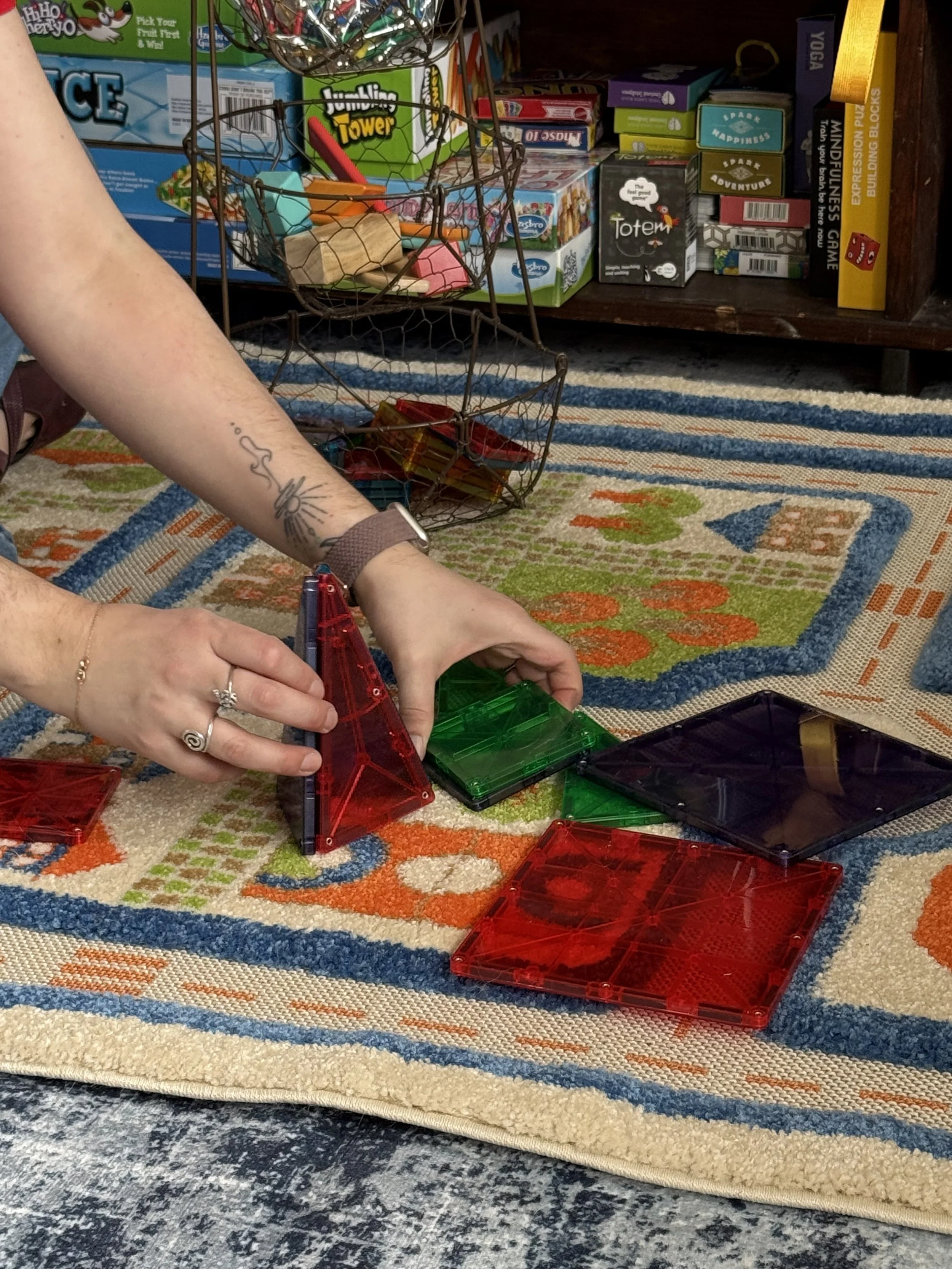
Occasionally, I meet with skeptics who walk into my office, see the array of games, dollhouses, blocks, art supplies, and movement tools, and ask:
“How can play be healing?”
It’s an important question.
And the answer is not just rooted in my personal story—it is strongly supported by developmental science, trauma research, and neuroscience.
Play is the natural language of children.
Children often do not yet have the cognitive or verbal development needed to explain complex emotions such as grief, trauma, fear, or anxiety in words.
Developmental research shows that before abstract reasoning is fully developed, children communicate internal experiences through symbolic play, storytelling, movement, and sensory exploration. This is why play therapy is often described as meeting children in their “native language.”
Research has consistently shown that play therapy is an evidence-based practice effective in treating depression, anxiety, trauma symptoms, aggression, emotional regulation challenges, social skills difficulties, and attachment concerns.
One of the strongest pieces of evidence comes from a meta-analysis of 93 studies, which found that play therapy has moderate to high positive effects across emotional and behavioral concerns.
Trauma is often processed through the body and nervous system.
Play therapy allows children to recreate, reorganize, and gain mastery over difficult experiences in a safe symbolic way.
For example, a child who has experienced chaos may repeatedly line up toys, build protective forts, or reenact themes of separation and reunion.
This repetition is not random.
It is often the nervous system’s way of trying to process, organize, and integrate overwhelming experiences.
This aligns closely with modern trauma science, including bottom-up regulation and somatic processing approaches.
Play supports self-regulation and stress recovery.
When a child is co-regulated by a therapist through rhythm, predictability, sensory play, and relational attunement, this can support:
- decreased sympathetic arousal
- an improved sense of safety
- greater emotional flexibility
- an increased window of tolerance
Pretend play builds resilience and emotional integration.
When children imagine different endings, roles, and outcomes in play, they are strengthening:
- agency
- problem-solving
- emotional flexibility
- a sense of control
Through play, children practice new beginnings to old fears.
Play is not “just play.”
For children, it is one of the primary ways they communicate, regulate, and make meaning of their world.
Research consistently shows that play therapy supports reductions in anxiety, trauma symptoms, behavioral challenges, and emotional distress.
Because children often lack the developmental capacity to fully verbalize their inner experiences, play offers a symbolic language through which feelings, fears, and relational wounds can be safely expressed and processed.
Neuroscience further supports this approach, suggesting that many early experiences are stored through sensory and emotional pathways, making embodied and relational interventions such as play therapy profoundly effective.